

Behind Every Paving Project Is a Purpose
When people see a freshly paved street, they see the finished product.
What they don't see is the ongoing planning, coordination, and collaboration behind each paving project.
Paving is one of the most visible examples of municipal government at work, but the asphalt itself is only the final step in a much longer process. Long before the first piece of equipment arrives, our city team is evaluating roadway conditions, reviewing community requests, coordinating with contractors, and developing a paving program that balances need, available funding, and neighborhoods across Charleston.
"Our streets connect people to work, school, businesses, parks, and one another," said Mayor Amy Shuler Goodwin. "Maintaining that infrastructure is one of the most important ways we care for our neighborhoods and the people who call them home."
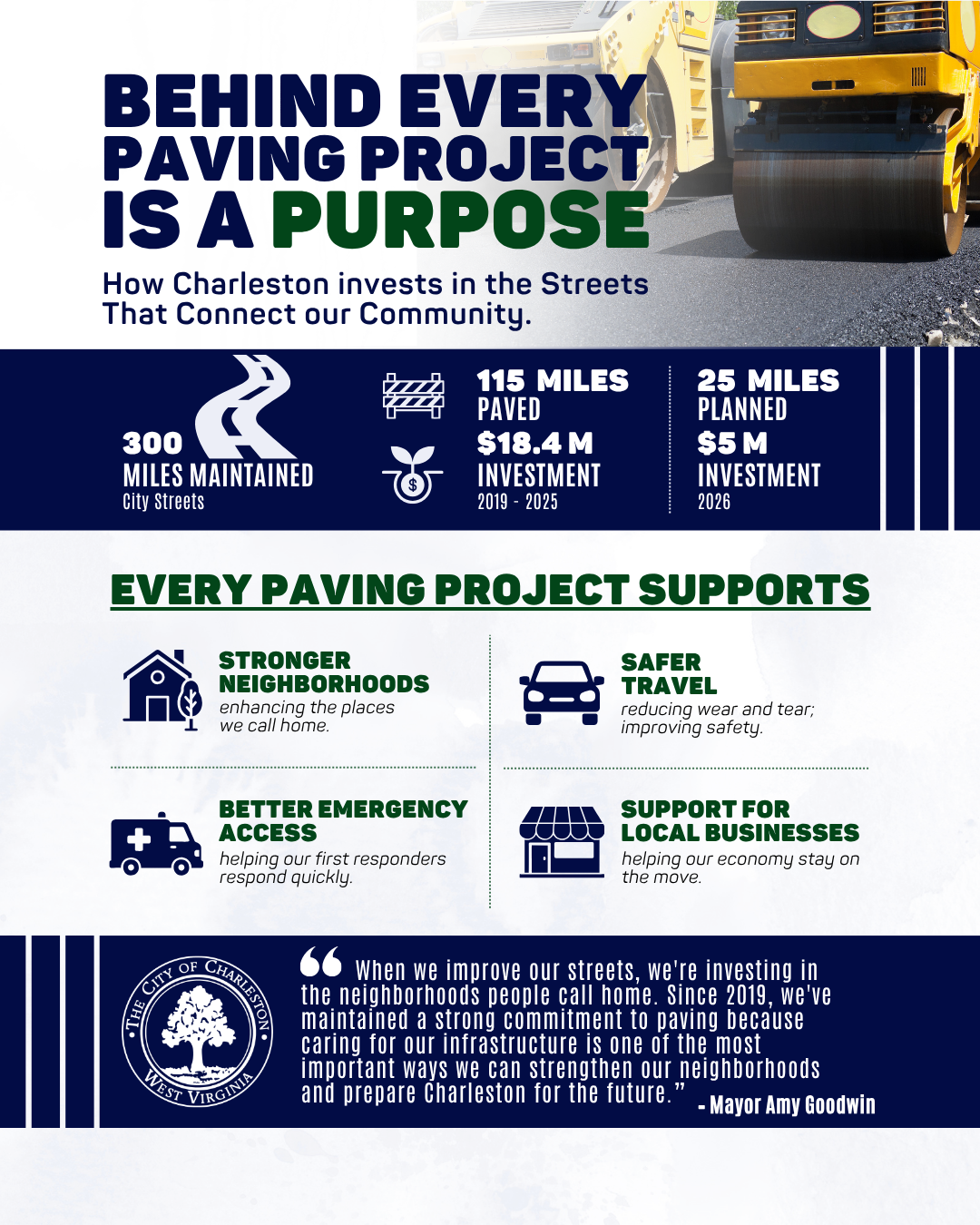
From 2019 through 2025, the City paved more than 115 miles of roadway and invested more than $18.4 million in its paving program. That long-term commitment has allowed Charleston to make consistent improvements throughout the city while preserving and extending the life of its transportation network.
With approximately 300 miles of City-maintained streets and a finite annual paving budget, Charleston cannot resurface every road every year.
Instead, engineering staff evaluate roadway conditions, prioritize streets in the greatest need of repair, and work to distribute paving projects across the City's wards. The goal is to make the best use of taxpayer dollars while delivering the greatest benefit to residents.
Paving priorities are continually reviewed and refined. Some streets may be identified for future improvements but not rise to the top of the priority list until a later paving cycle. Throughout the year, Engineering also considers requests from residents and City Council members when evaluating future projects.
Another important consideration is that not every roadway within Charleston's city limits is maintained by the City. Some streets fall under the jurisdiction of the West Virginia Division of Highways, while others are privately maintained. Projects such as Oakwood Road—a heavily traveled, state-maintained roadway serving three local schools—demonstrate how the City and the West Virginia Division of Highways work together to improve infrastructure that benefits Charleston residents.
Once a street is resurfaced, the goal is to provide many years of reliable service. While pavement may last 10 to 15 years under ideal conditions, factors such as weather, drainage, traffic volumes, and winter maintenance can shorten that lifespan. That's why every paving decision is made with both today's needs and the long-term condition of the City's transportation network in mind.
Selecting a street is only the beginning. Before paving begins, City departments work alongside contractors to coordinate schedules, review drainage, and address conditions that could affect the project. Even seemingly small details—such as driveway transitions and curb elevations—often require conversations with homeowners to balance proper stormwater drainage with individual property needs.
When paving work is scheduled, the City and its contractor work to keep residents informed through a variety of communication methods, including door hangers, notices on parked vehicles, the City's Traffic Information page, and other communications channels. The City understands that construction can be inconvenient. As with any construction project, weather and unforeseen conditions can affect schedules, and the City appreciates residents' patience as crews work to complete improvements as safely and efficiently as possible.
For City Council Member [and former Fire Chief] Chuck Overstreet, well-maintained streets are about more than smoother rides—they're about public safety.
"Every minute matters when first responders are answering an emergency call," said Council Member Overstreet. "Maintaining our streets helps ensure police officers, firefighters, and EMS personnel can respond safely and efficiently when our residents need them most."
This paving program is just one example of the work happening every day across our city.
The next time you drive down a freshly paved street, remember that what you see is only the final layer of a much larger effort. Behind every paving project is a purpose, and behind every purpose are people working every day to serve Charleston.
View the 2026 Paving List on Civic Clerk.
###